Taking on More Civil Engineering Work Without Adding Headcount
Automate document review and takeoff to reclaim engineer hours for billable work.
- Written by
- Theo JarvikContributing Writer, Small Firm Strategy
- Published
- October 10, 2026
- Reading time
- 11 min read
What this covers
A principal looks at the pipeline and sees three projects worth pursuing, a team that is already working late to close out the two projects already on the books, and a hiring market that makes bringing on another PE a twelve-month commitment with no guarantee the work will still be there to justify the salary. That tension sits at the center of most mid-size civil practices right now: the work exists, the staff is stretched thin, and adding headcount feels like betting the firm's margin on a market nobody is confident will hold. The real constraint is the share of engineers' hours going to work that doesn't actually need an engineer's judgment to complete. A firm can hire its way to more capacity, but that adds payroll cost before it adds a single billable hour of output, and it does nothing to fix how the existing team's time gets spent. Civil engineering firms face mounting pressure to turn around more proposals, deliver designs faster, and keep tighter oversight on active projects, all without growing payroll to match, and that pressure defines the operating reality for small and mid-size practices today.
The frustrating part is that most firms already know something is wrong. Surveys of architecture and engineering firms show adoption of AI tools has climbed sharply in recent years, and plenty of principals can describe, in detail, the workflow that eats the most hours in their office. The gap is that only a fraction of engineering firms, roughly 27% according to industry surveys, actually use AI for automation, problem-solving, or decision-making at any real scale. Firms are developing strategies and talking about the problem in partner meetings, but intention and implementation sit far apart, and the distance between the two is itself consuming capacity. Every month spent discussing a fix without deploying one is a month of engineer-hours still going to work that doesn't need an engineer.
How to locate the workflows consuming disproportionate hours
Before any firm spends money on a tool or a pilot program, it needs a clear picture of where its engineers' hours actually go, because the workflows draining the most time are rarely the ones leadership assumes. Principals tend to point to the most technically demanding projects as the time sink, but a close look at how hours break down usually tells a different story. The fix starts with a simple exercise: build a matrix that ranks every recurring workflow in the office by three measures, cost, time commitment, and staff stress.
The workflow worth tackling first is the one combining the highest staff stress with the cleanest, most consistent data, because that combination makes it the easiest to fix and the most painful to leave alone. Before layering any tool onto a workflow, a firm has to look honestly at its data maturity. If submittals, RFIs, or project files still live on paper or scattered across disorganized shared drives, that disorganization has to get addressed first, because no tool can compress a search through files that were never organized to begin with.
Setting a baseline matters as much as picking the workflow. A goal like cutting RFI processing time from five days to two is something a firm can measure and hold itself to. A goal like "use AI more" gives a team nothing to check progress against. Many principals believe they already know where their bottleneck sits, and the audit often proves them wrong in a specific way: the real drain usually sits one step upstream of where leadership assumed, with document review consuming engineer time before design work has even started.
Document-heavy workflows as the first and highest-yield target
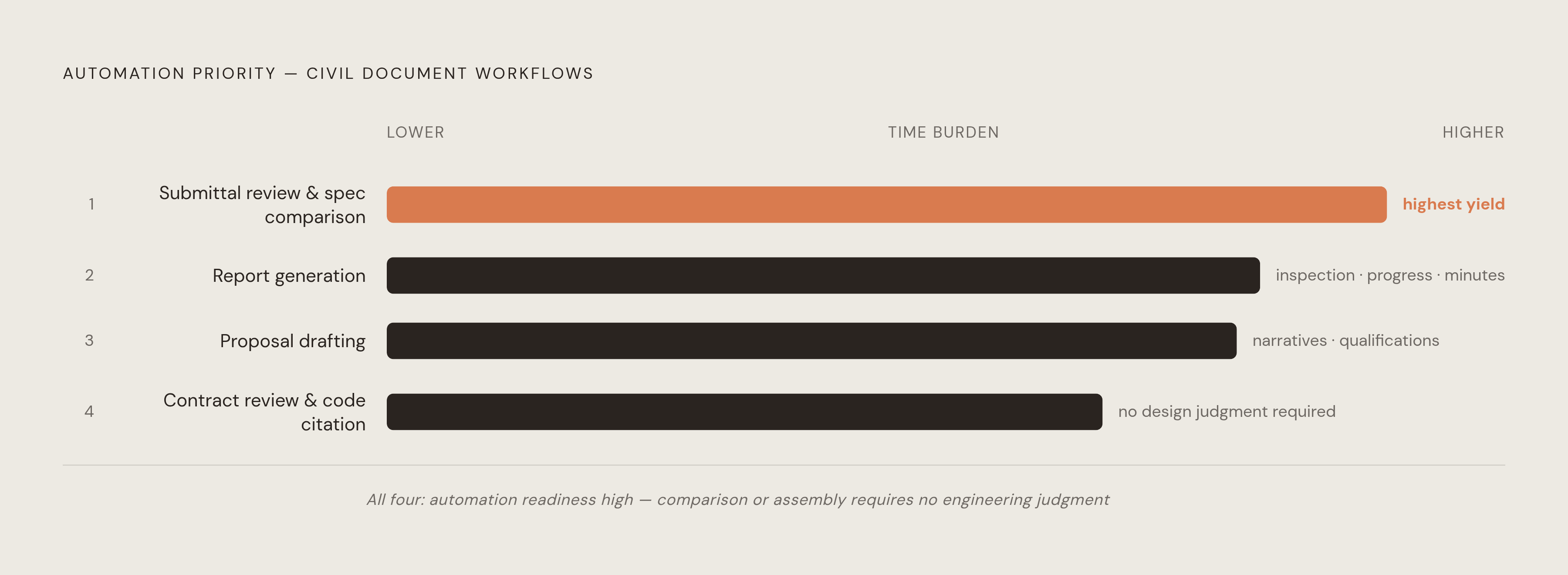
Submittal review, compliance checking, proposal drafting, and contract review eat a disproportionate share of engineer hours in civil practices, and they make the easiest starting point because none of them require touching design software. Checking a submittal against project specifications, cross-referencing a drawing against code requirements, or assembling a proposal narrative from boilerplate and project history, none of that demands engineering judgment at the comparison or assembly stage. The judgment comes later, when someone has to interpret what the comparison turned up and decide what to do about it.
Tools built for submittal review can pull the technical characteristics out of a submittal package and check them against project specifications automatically, turning what used to be a manual cross-referencing exercise into a flagged list an engineer reviews in minutes. Contract and compliance review tools work the same way: they scan documents against building codes and project specifications and cite the exact pages and sections where a conflict appears, so the engineer's job becomes reviewing what got flagged instead of hunting through two hundred pages to find it.
Right now, document workflows where this kind of tool genuinely helps include submittal review and spec comparison, proposal drafting (technical narratives, executive summaries, qualification statements), contract review with code citation, and report generation for things like inspection reports, progress updates, and meeting minutes. Natural language processing tools can also summarize RFIs and meeting notes, flag cost anomalies, and surface risks buried in emails and project logs, which trims project management overhead without taking the PM out of the actual decision. An engineer still has to sign off on what the comparison found and decide what it means for the project. What changes is where the hours go: time that used to disappear into hunting through spec sheets or reformatting the same qualification statement for the tenth submission becomes time available for the next billable task in the office, and that redirection is the entire point of starting here.
Quantity takeoff and cost estimation as the second recoverable time sink
Manual quantity takeoff ranks among the largest pre-billable time sinks in civil engineering, and it follows the same pattern as document review: automate the comparison and measurement, keep the judgment with the estimator. Traditional takeoff asks experienced engineers to measure drawings by hand, count elements one by one, and calculate volumes for earthwork, drainage, and concrete, work that is tedious and prone to error without ever calling on the kind of judgment an engineering license is meant to protect.
Tools built for AI-assisted takeoff can detect, measure, and compare quantities straight from construction drawings, covering earthworks, drainage, and concrete, and they compress what used to take days into a fraction of that time. That frees the engineer to spend time on interpretation and pricing decisions. Pre-construction tools, including estimation and takeoff platforms, make up one of the fastest-growing segments of the AEC software market, and the reason is straightforward: fewer hours per estimate, fewer errors per project, and more bids a team can submit in the same stretch of time.
Accuracy varies by drawing quality and project complexity, so any firm evaluating these tools should test vendor claims against its own typical project types. The throughput gain here isn't abstract. A firm that cuts the hours it spends estimating a given pursuit can chase more work without hiring a dedicated estimator, or it can put those recovered hours straight into the projects it has already won.
Design and analysis workflows where automation reclaims hours inside Civil 3D and related tools
The biggest remaining pool of consumed hours sits inside the design software itself, in the repetitive modeling, routing, and documentation tasks that civil engineers run through on nearly every project with only minor variation from job to job. Stormwater control design is a clean example of how this plays out in practice. Civil 3D 2026.2 shipped with more than 75 new Dynamo nodes built to automate stormwater control workflows, so scripting now handles repetitive design tasks directly inside the software civil engineers already use every day, without a separate platform or a change in how the firm delivers work.
Generative design tools go a step further, running through thousands of layout and structural options against a set of constraints, like cost, performance, and code compliance, and producing alternatives for a designer to evaluate. That approach fits especially well with repetitive layouts, drainage routing, and early massing studies, the kind of work where the range of reasonable options is large but the evaluation criteria are well defined. AI agents working inside a Model-Context-Protocol framework can take a design problem, operate across multiple software tools on their own, and generate proposals, so the manual setup and repetitive modeling engineers otherwise handle themselves on complex problems drops.
Predictive design pushes this further still. Systems built for it can forecast how different design options will hold up structurally, financially, environmentally, and against regulatory requirements, which reshapes the design-review loop so that engineers spend their time curating AI-generated proposals. None of this works reliably without a foundation of clean data: well-organized BIM models, consistent analysis inputs, verified reference libraries, and functioning feedback loops connecting design, construction, and operations. If you skip that foundation, AI-assisted design produces output nobody can trust. AI assists the engineer's judgment in this process. It does not replace it, and professional liability, design creativity, and the stamp that goes on the final drawings stay squarely with the licensed engineer.
Running a materially higher project volume with the same team
Redirecting hours out of document review, estimation, and repetitive design tasks does more than speed up individual steps. It changes what a fixed team is capable of delivering over the course of a year, and the right way to measure that change is revenue per person and total project throughput, not hours saved on any single task in isolation. If a firm trims time off submittal review but never converts those hours into additional project scope, it hasn't actually gained capacity. It has just made the same workload a little more comfortable.
The scale of the opportunity is concrete. Machine-learning estimators trained on a firm's own historical project data can hit tight accuracy on line-item costs, and the time savings run to roughly 260 hours per project manager each year. For firms where PMs already run at full stretch, recovering 260 hours is a shift in how much work that person can carry, not a marginal convenience. Firms that have already moved from talking about AI to actually running it in production are reporting real returns, with early adopters citing savings of tens of thousands of dollars and hundreds of hours from these tools, while most firms in the industry are still watching from the sidelines.
That gap has competitive consequences. When firms convert workflow-level time savings into additional project volume, they pull ahead of firms still staffing at the same throughput rate they always have, closing more pursuits and taking on more work with the same number of people on payroll.
Running a first pilot without disrupting ongoing project delivery
The objection almost every principal raises at this point is fair: a firm can't pause active project delivery to run an experiment. The firms seeing the fastest returns from AI tools don't attempt a firm-wide rollout. They pick one workflow, assign one team, define one measurable outcome, and only expand once that first pilot proves itself out.
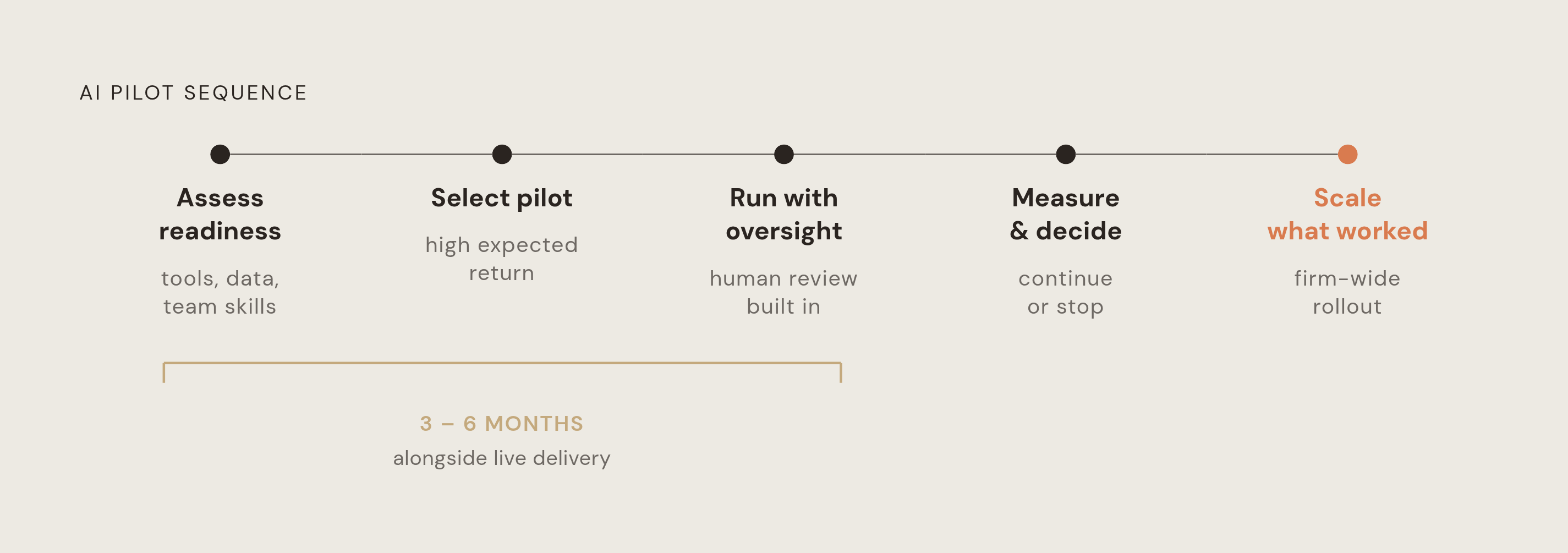
A five-phase structure works well for mid-market AEC firms: assess readiness, select a pilot with high expected return, run it with human oversight built in from the start, measure the result and decide whether to continue, then scale what worked. Most firms can get through the first three of those phases in three to six months, a timeline short enough to run alongside active project delivery.
Data readiness has to come before any tool gets introduced. A firm still running core workflows on paper or scattered across disorganized shared drives needs to fix that first, because a detail library that was never organized in the first place can't be searched by anything, no matter how capable the tool is. The pilot itself should target the workflow with the highest staff stress and the cleanest available data, not the most impressive piece of technology or the most technically demanding engineering challenge on the books.
Human oversight is the permanent operating model, not a transition measure to be phased out once the team trusts the tool. Every AI-assisted deliverable in licensed engineering work has to be reviewed and stamped by a licensed professional, and that accountability structure is what makes the output usable and defensible to clients and licensing boards alike. Cultural resistance inside the firm is a real obstacle, and the firms that get past it tend to frame these tools as something that removes repetitive work rather than something that threatens anyone's expertise, identifying internal champions early rather than mandating adoption from the partners down. Data security deserves the same seriousness as the engineering work itself: tools that run on a firm's own infrastructure and don't train on client data remove the trust barrier that otherwise stalls adoption, and that should be treated as a selection criterion from the start, not a question asked after the contract is signed.
The compounding effect: what consistent throughput gains look like across a full year
Workflow-level gains don't stay isolated to the task where they started. Time recovered from document review funds more capacity for design work, more design capacity funds more completed projects, and more completed projects raise revenue per person without a matching increase in headcount. A firm that closes the gap between what it currently delivers and what the same team could deliver doesn't just finish this year's projects a little faster. It permanently changes how much work that team can carry.
AI adoption across AEC is accelerating, and the vast majority of firms already using these tools plan to expand how they use them. The distance between early adopters and everyone else is growing. For small and mid-size civil firms, that capacity advantage carries extra weight: tools that give a lean team more production capacity per person let that team compete for project volume that used to require a much larger staff. Firms standing still compete against firms compounding their throughput gains year over year, and that widens the gap on both sides at once.
The question a principal should be asking is what a project is worth to the firm, and how many more of those projects the same team can close in a year once the non-judgment work stops competing for their engineers' time. That calculation, not the price tag on any single piece of software, is what actually justifies the investment.