Engineering Utilization Rates at Small AEC Firms
Small AEC firms face outsized profit risk when utilization drops below industry benchmarks.

- Written by
- Renata Solís-Kwame
- Published
- October 13, 2026
- Reading time
- 10 min read
What this covers
Utilization rate measures the percentage of total available staff hours spent on billable, revenue-generating work, and it is the single number that connects how a firm deploys its people to whether that firm makes money. The formula is plain: billable hours divided by total available hours, multiplied by 100. A designer who bills most of her available hours in a given month looks strong on paper, and that read is easy to confirm at the individual level. The harder task, and the one that actually matters to a firm's bottom line, is aggregating that number across every role and every project to get an honest firm-wide picture.
Separating utilization from two metrics it often gets confused with clarifies what each one measures. Billability describes the share of a person's time spent on work that could be billed to a client, a related but distinct idea from how much actually gets billed. Realization describes the share of billable hours that convert into invoiced and collected revenue, since logging an hour and getting paid for it are not the same event. Utilization sits upstream of both. AEC firms run on labor: revenue comes from hours, cost comes from hours, and profit is simply the spread between the two. That is why utilization carries more diagnostic weight here than it would in a product business or even in general contracting, where materials and subcontracted trades absorb a much larger share of cost and risk.
Why small firms are especially exposed when utilization slips
A small AEC firm's capacity to absorb a utilization drop is tied to its size, so the exposure is structural, rooted in scale itself. Every non-billable hour at a five-person studio represents a much larger share of total capacity than the same hour would at a 150-person platform, and a small firm's cost structure leaves thin room for error before margins disappear.
Small firms also run on lower average EBITDA margins than mid-market or large platforms to begin with. The Engineering Market Outlook 2026 puts small firm average EBITDA margins in the 10-16% range, well below the ranges reported for mid-market and large platforms. A smaller margin cushion means a smaller utilization drop is enough to push a firm from profitable to unprofitable. A three-person or five-person studio cannot carry bench time the way a larger firm can. One key person spending a month on non-billable work is a measurable revenue gap at that scale, not a rounding error buried in a larger payroll.
The overhead rate compounds the exposure. None of this reflects poor management. It reflects the plain fact that a small firm has less redundancy built into its structure, so the same percentage drop in utilization does more damage, faster.
Industry data on firm utilization
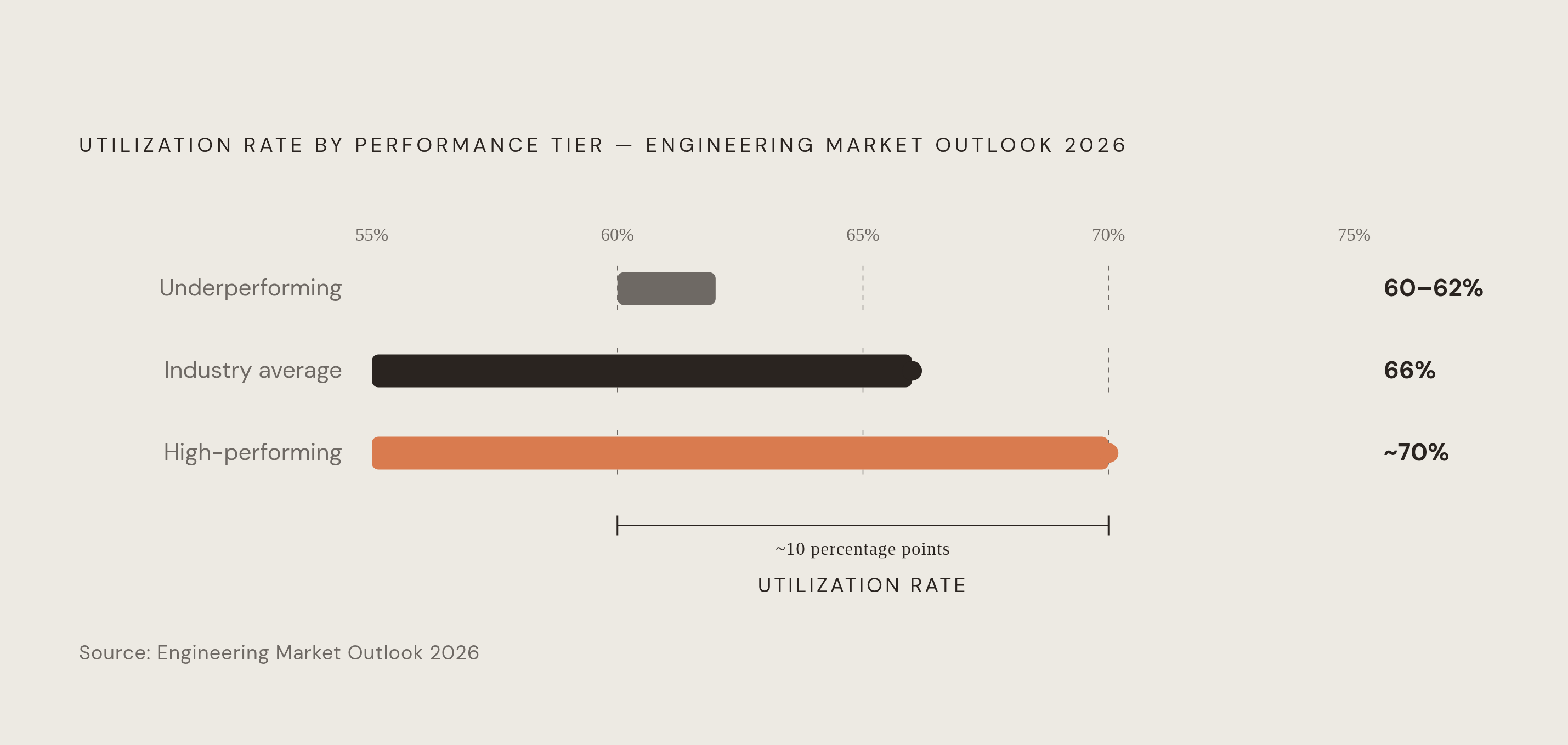
Most AEC firms are not hitting optimal utilization, and a meaningful share of them do not track the number consistently enough to know where they actually stand. Average firm-wide utilization across the industry clusters in a narrow band, yet that narrow band produces a wide spread in operating profit between firms. The Engineering Market Outlook 2026 shows underperforming firms landing around 60-62%, an industry average near 66%, and high-performing firms closer to 70%, a range of roughly ten points that corresponds to a substantial difference in operating profit between the firms at the bottom and the firms at the top.
Separate benchmark data from an architecture and engineering industry report puts average utilization near 81% when measured only across billable staff, a figure that looks much higher than the Engineering Market Outlook numbers because it uses a narrower denominator. The number only means something once a firm is consistent about how it calculates it, period over period.
A significant share of firms do not track utilization at all, or track it inconsistently enough that the number is unreliable. Many principals are managing one of their most important profit levers without a dependable read on it. The distance between an average firm and a top-performing firm on this metric is not a rounding difference. It appears directly in operating profit, and closing that gap starts with knowing, role by role, what a healthy number actually looks like.
Utilization targets by role
A single firm-wide utilization target hides the legitimate variation that exists across roles, and holding every position to the same number leads to bad decisions about staffing, workload, and where to focus improvement effort. Non-billable work is not spread evenly across a firm by accident. Some roles are structurally built around billable output, and others are built around tasks that will never appear on an invoice but still drive the firm's future.
Project managers, for example, tend to target around 88% utilization, since most of their time is client-facing or production-adjacent, with coordination calls and internal check-ins making up the bulk of what little non-billable time they log. Pushing a principal's utilization above that range risks starving business development at the exact moment a firm needs it most.
Firm size shifts this picture further. A firm-wide target in a healthy range is really an average across these role-level realities, so falling below a profitable threshold signals a real problem, while pushing every role too high signals that the non-billable investment a firm needs, training, business development, internal process work, is being squeezed out. These figures are reference points, not hard rules. A principal at 72% is performing well. A job captain sitting at that same number probably is, and the context of the role is what makes that distinction meaningful.
How utilization connects to other financial metrics
Utilization is one of three variables that drive the net multiplier, the ratio that most directly measures whether a firm is converting labor into revenue at a profitable rate. N* Finance's guide to AE firm financial metrics identifies the three levers that move the multiplier as billing rates, utilization, and labor mix, and utilization is the one most directly under a firm's day-to-day operational control. A firm that improves utilization without paying attention to how it interacts with billing rates and labor mix may not see the profit improvement it expects, because the multiplier moves on all three variables together.
Utilization also feeds the break-even rate. Realization is the next filter a firm needs to apply after utilization, because a firm can show high utilization and still be in trouble if realization is low, meaning billable hours get logged but never collected. A firm in that position is busy without being profitable, and tracking both numbers together is what prevents a false sense of health. Scope creep, write-downs, and billing disputes appear in realization numbers, so a principal watching utilization alone can miss a realization problem building there.
Labor mix matters too. Utilization gains are worth more when a firm's staffing pyramid is healthy, one more reason to read the three levers together. None of this requires a principal to become a financial analyst. It requires enough fluency to use utilization as a lever with an understanding of what else it touches.
Why most small firms cannot see their utilization problem in time
Industry research describes a pattern among small AEC firms where utilization and project financials get managed through manual processes that produce information too late to change the outcome. A firm that has the right metric in mind can still fail to act on it because the systems producing that number are too slow or too fragmented to catch a problem while there is still time to fix it.
Cash collection lags make this worse. Firms without time tracking, project management, and financial reporting systems connected to one another have no way to see utilization trending down before it hits margins. They see the effect on margin only after the fact, once the damage is already in the books. Many small firms are profitable in the aggregate yet unable to say which projects or which time periods actually drove that profit or loss. Without that visibility, a firm cannot repeat what worked or stop what did not.
This is a systems and visibility problem, not a talent or effort problem. A firm can be busy, staffed with talented people, and full of loyal clients, and still be flying blind on whether the work is actually paying off.
The operational levers that move utilization at a small firm
Three controllable factors drive utilization at a small AEC firm: contract type and scope discipline, staffing strategy and work allocation, and how non-billable time gets assigned and tracked. Moving the number requires working on all three, not just pushing people to log more hours.
Contract type sets the terms before a project even starts. Lump-sum contracts pin profit to unspent hours, so scope discipline and a detailed work breakdown at the outset are the main defense against idle bench time quietly eating into a fixed fee. Building change-order discipline into lump-sum work is one of the highest-leverage moves a small firm can make, since it keeps staff working on compensated hours rather than absorbed into scope growth nobody tracked.
Staffing strategy is the second lever. Over-hiring relative to backlog creates bench time that drags utilization down, while under-hiring forces senior staff onto production work that should go to junior staff, misaligning labor cost against billing rate. A healthy staffing pyramid, junior staff on production, senior staff on oversight and business development, keeps direct labor cost low and keeps utilization high among the people who should actually be billing. Assigning work based on who happens to be free, rather than who is right for the task, is one of the most common sources of utilization drag at small firms. It produces two problems at once: expensive staff doing simple work, and the right person unavailable when a project needs them.
Non-billable time management is the third lever, and it starts with recognizing that non-billable time is not inherently wasteful. Business development, training, and internal process work are investments in the firm's future. The problem arises when non-billable time goes untracked, unplanned, or falls on roles that should be billing instead. Principals who absorb administrative and IT tasks that could be delegated or systematized are the most common source of principal-level utilization drag at small firms. Tracking non-billable time by category, business development, administration, training, internal meetings, gives a principal visibility into where those hours are actually going, which is the first step toward deciding whether they are going to the right places.
How AI-assisted workflows change the utilization equation
AI tools that take on technical production work, drafting deliverables, running calculations, populating models, change both the numerator and the denominator of the utilization calculation at once. The question shifts from how to get more hours billed to how to get more project throughput out of the same headcount, a more powerful version of the same underlying goal.
When AI handles work that used to absorb junior or mid-level hours, those staff can move to higher-value billable tasks, or the firm can take on more projects without adding headcount, raising revenue per employee without requiring the utilization rate itself to climb. The more precise measure for a firm using AI assistance well is not utilization rate on its own but project throughput and revenue per person. A team that finishes projects faster with the same headcount is improving financial performance even if utilization, hours billed divided by hours available, barely moves.
Tools that fit into a firm's existing software environment preserve utilization because staff spend fewer hours switching contexts or re-entering the same data twice. Accountability does not disappear in any of this. Firms should factor that review time into how they calculate the utilization gains AI assistance actually delivers. AI is not a substitute for utilization discipline. A firm that already tracks and manages utilization well will get more value out of AI assistance than a firm that does not.
What stable, well-managed utilization signals to buyers
Disciplined utilization management is one of the operating facts that gives buyers confidence in a firm's earnings, and the same discipline that makes a firm attractive to a buyer is what makes it competitive and sustainable for an owner who has no intention of selling. The AEC M&A Trends 2026 report identifies stable utilization as one of the operating facts that moves buyer willingness to pay, noting that weakness in these areas often leads buyers to demand more structure in a deal or to reserve value for an earnout or rollover.
Two firms can show identical revenue and identical EBITDA and still trade at very different valuations. The one with durable margins, stable utilization, and client relationships that do not depend entirely on one principal commands a higher price than the one with volatile utilization, thin project controls, and heavy principal dependence. For a firm with no plans to sell, the same logic holds internally. Consistent utilization discipline is what lets a principal know whether growth is sustainable, whether a new hire is actually justified by backlog, and whether the firm can take on a larger project without putting its margin at risk.
Competitive pressure on small firms is building, and it is not evenly distributed. The firms that stay competitive five years from now will not necessarily be the largest ones. They will be the ones that built the operational foundations now, and a firm's handle on its own utilization is one of the clearest foundations it can build.